
1.
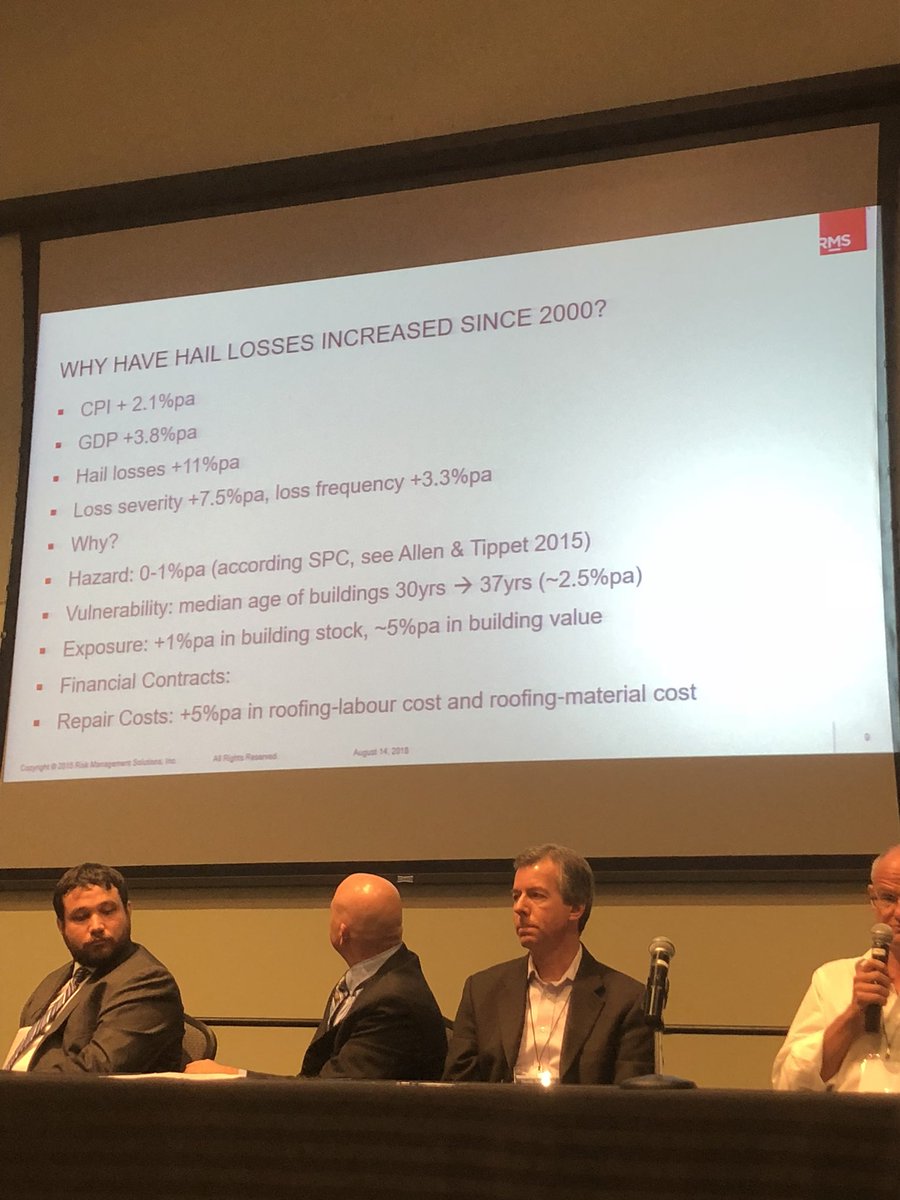
Notice according to @rms hazard is only accounting for a 1% increase in loss since 2000. The rest is social economic factors have a much bigger impact on higher insurance loss. #hail2018 pic.twitter.com/oTkP4IMBfV
— Andrew Siffert (@AndrewSiffert) August 14, 2018
2.
Interesting point...going over damage claims, median age of homes is increasing. Are people not replacing their roofs at a time where they need to be? #Hail2018 pic.twitter.com/LLgTIZVYY9
— Bryan Wood (@bryanwx) August 14, 2018
3.
Attendees who are not in the insurance industry...are you sufficiently confused by how crazy our industry is? 😂 #hail2018
— Bryan Wood (@bryanwx) August 14, 2018
4.
Now onto the fun stuff. How is all the hail research applied to understanding the risk in terms of 💰. Talking about how the cat models use the science and calculate the insurance loss. #hail2018 pic.twitter.com/ie4UJYSTX1
— Andrew Siffert (@AndrewSiffert) August 14, 2018
5.
“The (insurance) industry has a little bit of jargon.” Understatement of the year. #Hail2018 pic.twitter.com/uVfQrlpDHv
— Bryan Wood (@bryanwx) August 14, 2018
6.
How will #hailstorms change in #climatechange? @ColoStateNews's Kristen Rasmussen says in 100 years we can expect that storms will intensify, meaning more storms with large hail. #Hail2018 #stormintensification pic.twitter.com/ZKXFkZ1WXe
— NCAR Science (@NCAR_Science) August 14, 2018
7.
If your in the insurance industry check this research out. #hail2018 pic.twitter.com/dQxBQOTqCp
— Andrew Siffert (@AndrewSiffert) August 14, 2018
8.
Urban sprawl is an issue for hail and how severe convective thunderstorms are represented in catastrophe models. Hazard is aggregated to coarse grid cells in previously non-concentrated population areas under-representing the risk #hail #Hail2018 #severeweather @AndrewSiffert https://t.co/TH97DIHl3g
— Tina Thomson (@mktinth) August 14, 2018
9.
Want to make hail? You need the right recipe, says #NCAR’s Andreas Prein: high buoyancy, differences in wind speed and direction, moisture, and a low freezing level.
— NCAR Science (@NCAR_Science) August 14, 2018
Viola! You have the conditions for hail! #Hail2018 #hailstorms #hail #weather pic.twitter.com/wiy2BSgUen
10.
@WalkerSAshley & @StephenMStrader cited 3-4 times already for their great work on increasing exposures to perils in the US. You can find their work here: https://t.co/46vxztVTvh #Hail2018
— Bryan Wood (@bryanwx) August 14, 2018
11.
Brian Tang showing estimated damage swaths derived from radar from the 2010 Phoenix hail storm, the costliest in US history. #Hail2018 pic.twitter.com/ExLXq4CSDA
— Bryan Wood (@bryanwx) August 14, 2018
12.
How much damage does #hail cause in the US? More than tornadoes, straightline winds, and lightning, according to @disastersafety's @igiammanco33 at the #Hail2018 workshop.
— NCAR Science (@NCAR_Science) August 14, 2018
"It is the Rodney Dangerfield of weather, it just doesn't get respect!" -Ian Giammanco pic.twitter.com/cdgxWy9keB
13.
Great to see some @RPI_20 work being presented here at #hail2018 this is very important work for the insurance industry. pic.twitter.com/OdlkjJKF7G
— Andrew Siffert (@AndrewSiffert) August 14, 2018
14.
Ready to talk hail and hailstorms? Our experts are ready for the #Hail2018 press conference! From left to right: Andreas Prein (NCAR), Kristen Rasmussen (@ColoStateNews), @igiammanco33 (@disastersafety), and Andrew Heymsfield (NCAR). #hail #hailstorms #weather #NCAR pic.twitter.com/1JjxwlwCDe
— NCAR Science (@NCAR_Science) August 14, 2018
15.
.@SteveBowenWx Reports of large hail >2” diameter over Doppler Radar era (since 1990) are increasing, but the trend isn’t significantly significant. Yet. #Hail2018
— Mark C. Bove (@MarkCBove) August 14, 2018
16.
@SteveBowenWx showing lots of data as why one should not use insurance loss or economic loss data to determine a trend in hazard of hail. #hail2018 pic.twitter.com/8x1Pu5wpCm
— Andrew Siffert (@AndrewSiffert) August 14, 2018
17.
🍚 Super excited for the #Hail2018 workshop press conference to kick off here at NCAR. So excited, in fact, that I'm pretending this rice bowl emoji is actually a hailstone in a cup. 🍚#ScienceEmojis#HailYeah
— Laura Snider (@lauracsnider) August 14, 2018
18.
@SteveBowenWx brings up the crop loss as related to hail. #hail2018 pic.twitter.com/otuJDqoIOh
— Andrew Siffert (@AndrewSiffert) August 14, 2018
19.
.@SteveBowenWx of @Aon_plc comparing SCS vs TC losses by decade. SCS exceeds TC in all but one decade. #Hail2018 pic.twitter.com/BcrZ9Az5UQ
— Mark Bove (@SurlyOx) August 14, 2018
20.
@SteveBowenWx: Severe Weather usually outpaces hurricane loss in the US. The extreme seasons of 04-05 made 2000-09 an outlier. Over the whole period, hurricanes slightly outpace severe weather. #Hail2018 pic.twitter.com/tK5ORQML6l
— Bryan Wood (@bryanwx) August 14, 2018
No comments: